The 2026 Tenant Submetering Playbook for Property Managers

Property managers are masters of tenant financial services, from leasing and deposits to rent and fees. Some property managers are keen on deploying submetering solutions into their properties, but they are often faced with many technical challenges that prevent them from achieving this objective.
This playbook by LYNKED introduces a new model for how firms can bring utility bill payments into their trusted workflows, collect admin fees, and deliver a consistent experience under their brand, without expanding and complicating operations.
In this Post
- Why Tenant Submetering Matters More Than Ever
- The New Tenant Submetering Playbook
- Claim the Future of Property Management and Utilities
- Frequently Asked Questions (FAQs)
Why Tenant Submetering Matters More Than Ever
Tenant submetering, or smart metering, involves the integration of utility meters, such as electric, water, gas and thermal, to track usage at an individual unit level. This enables tenants to be billed on their actual consumption, instead of flat rates.
But it also opens the door to something bigger:
- Cost control: In-depth utility data helps tenants develop smarter habits and the insights needed to lower bills.
- Energy Efficiency: Visibility drives greater energy efficiency across the property and supports measurable savings.
- Property protection: Smart metering alerts help you and your tenants avoid waste and damage by detecting issues such as running toilets or fixtures, broken or frozen pipes, and other anomalies before they become emergencies and skyrocket costs.
- Stronger asset value: Smart metering infrastructure significantly improves efficiency, enhances management and increases a property’s valuation and competitiveness.
- Sustainability progress: Aggregated data can support ESG reporting and compliance with local performance rules.
- Better tenant experience: tenants and property managers have the right to fair and transparent billing.
The Steep Curve: What is Required to Begin Tenant Submetering
Tenant submetering looks simple on paper. In reality, the data path from a utility system to a final invoice is complex.
An integrated submetering system touches nearly every layer of your building’s infrastructure. Not only does this require numerous layers of technology, but it also requires a system to be properly designed, correctly installed, configured to transmit data in the appropriate format and protocol, and delivered into a software platform where it can be processed and distributed to billing systems and analytics tools.
It’s not just installing meters, it’s engineering an entire data ecosystem.
Here is what the full lift really requires.
1) Infrastructure and Hardware
- Large investment and financing to procure appropriate equipment
- Advanced IoT meter selection for electric, water, gas, and thermal
- Revenue-grade accuracy and applicable certifications
- Code-compliant installation, wiring, and safety
- Gateways, power, and protective enclosures
- Lifecycle plan for spares and firmware updates
- Asset management
2) Communications and Data pipeline
- AMI network design that reaches every device
- Reliable backhaul to the cloud with redundancy and uptime targets
- Time synchronization for clean interval reads
- Validation and estimation so gaps do not break bills
- Normalization across brands and models into a single format
3) Security and Compliance
- Encryption in transit and at rest
- Role-based access with audit trails
- Resident privacy controls and data minimization
- Alignment with local utility billing rules and disclosures
- Incident response protocols
4) Field Operations
- Alert logic that isolates real issues, not noise
- Leak and freeze detection that triggers action paths
- Work order routing to maintenance and resident services
- Device health checks for meters, gateways, and batteries
- Quality assurance on reads before statements go out
5) Bill Rules and Edge Cases
- Rate models, taxes, and fees for your market
- Master meter reconciliation and common area allocation
- Proration for move-ins and move-outs
- Dispute resolution with evidence on hand
- Final bill safeguards that protect cash flow
6) Finance and IT alignment
- Total cost model for hardware, licenses, and support
- Integration to accounting, building automation systems (BAS), customer relationship management (CRM), and residential portals
- Clear ownership across IT, finance, and site teams
- Vendor oversight with enforceable service level agreements (SLAs)
Despite having the operations in place to handle payment processing and support, the complexity of submetering is a non-starter for many property management companies.
Attempting to build and manage this alone would mean bloating operations with overhead and specialized staff. Even if you purchase the hardware, unifying devices, networks, validation, and billing logic takes constant engineering, quality checks, and uptime management.
How Technology Gaps Keep Tenant Submetering Out of Reach
Property management companies have typically faced insurmountable barriers preventing them from processing utility charges.
Many teams in the property and facility services industry are ready to deploy submetering into their properties, but they're faced with a massive gap between their operations and the technology and knowledge required to do tenant submetering properly.

From choosing the right meters and network protocols to securing data, integrating systems, and configuring everything for accurate, billing-ready performance, the process demands serious technical capacity.
For most property management companies, that means adding an entirely new division just to manage utility billing. Here’s where the technology gap often appears:
- Large Upfront Technology Costs
Building a modern submetering system in-house often requires significant capital investment in hardware, software, and integration—costs that can be hard to justify without a clear return path. - Closed Protocols and Devices
Smart meters and gateways often rely on proprietary configurations that are difficult to access or integrate into broader building systems. - Lack of Real-Time, Usable Data
Read-only portals offer limited exports, which make it hard to generate bills, answer tenant questions, or track usage with confidence. - Limited Data Rights and Added Costs
Exporting raw data often comes with fees or restrictions, making it harder to take ownership of your own utility intelligence.
The New Tenant Submetering Playbook by LYNKED for Property Management Firms
The new innovative approach to tenant submetering solutions that bridges the technology gap for property managers.
This new playbook, developed and powered by LYNKED, is based on a simple, powerful idea: bridging the tech gap between usage and utility payments
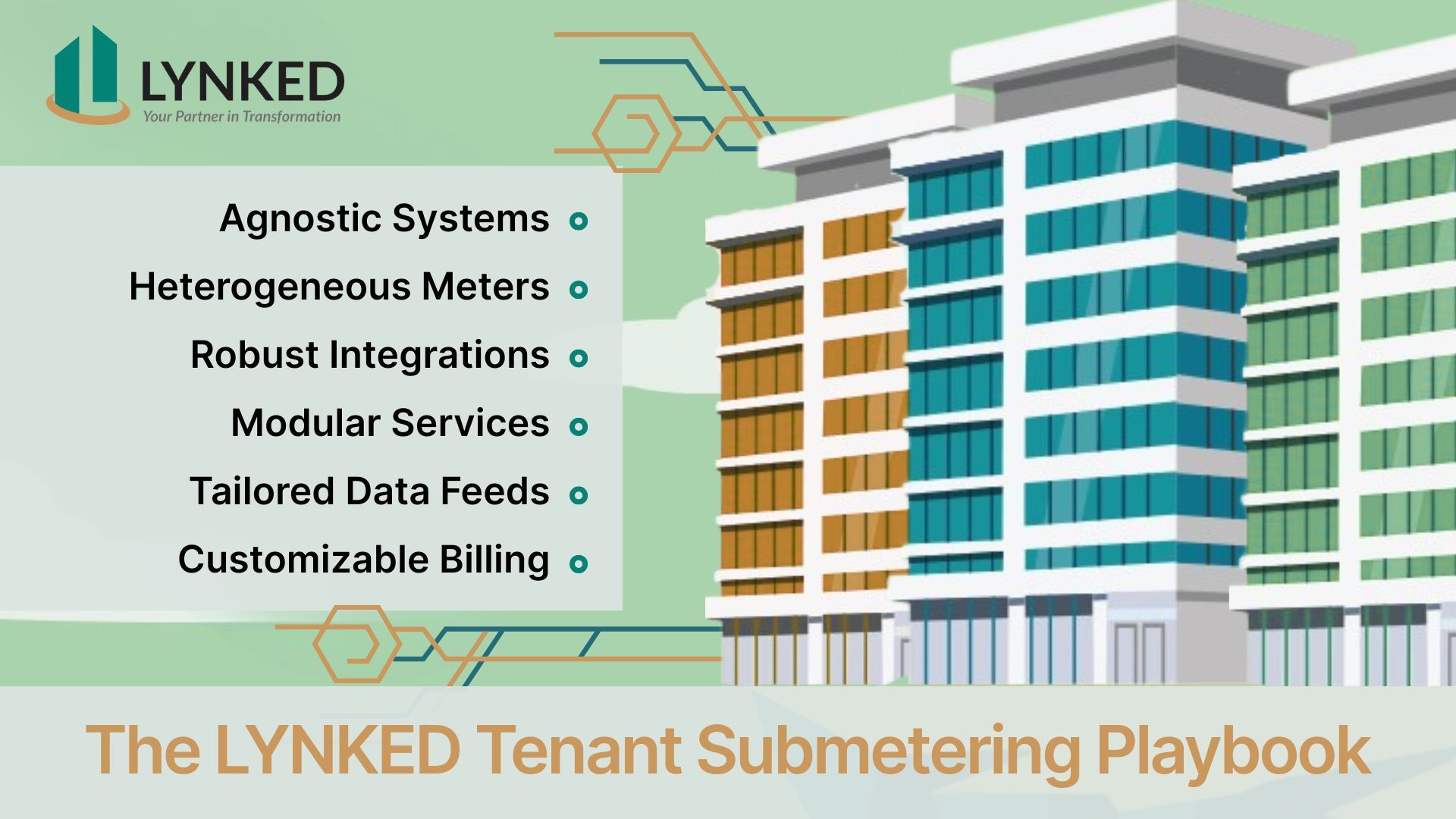
Customizable Branding for Billing Services
The Billing-as-a-Service model by LYNKED provides property management firms with access to customizable smart meter statements that are prepared, validated, and issued under their brand.
LYNKED provides as few or as many capabilities as needed to fill the technology gap of tenant submetering, so you can establish a new revenue source and deliver better client experiences for your residents and businesses.
This shift creates a superior experience not only for your firm, but for your tenants:
A Single Point of Contact: Tenants work directly with your firm, which ensures continued client satisfaction and rapid conflict and error resolution.
Billing and Payment Ease: Consolidated utility statements from your firm, which can be paid directly to you through your existing resident portal.
Unified Accounting (for Businesses): For commercial tenants, consolidated utility bills simplify accounting processes and statement records. This level of ease and integration gives your properties an edge over competitors.
How the Model Works
- Infrastructure - We help modernize your infrastructure, with costs offset over time by the new revenue generated through bill processing.
- Connect — No rip and replace by default. Build on any existing advanced metering infrastructure where it exists. Add only what is missing.
- Platform — LYNKED fits and fills gaps in metering, gateways, RF networks, and software so everything communicates within a unified IoT cloud system.
- Maintain — We manage meter and equipment lifecycles and system maintenance, including device health, firmware updates, and network uptime.
- Secure — LYNKED enforces strict data security with encryption in transit and at rest, role-based access, audit trails, and privacy controls.
- Validate — Check completeness, fill short gaps under approved rules, and keep a clear audit trail.
- Deliver — Push billing-ready files to your accounting tools and generate statements under your brand.
- Tenant Support — Your team holds access to records when disputes arise. Plus, your teams access real-time property intelligence alerting them to leaks, waste and emergencies to drive rapid action.
Results You Can Expect
- Statements go out on your schedule with complete data
- Admin fee revenue flows to you, not a third party
- One point of contact for tenants across rent and utilities
- Fewer disputes and faster resolution with usage evidence on hand
Claim the Future of Property Management and Utilities
The old era of tenant submetering is over.
With LYNKED as your partner in transformation, you can close the technology gap between you and your utilities.
Claim new revenue without bloating your operations. Strengthen and preserve tenant relationships. Continue to deliver superior property experiences.
Let LYNKED handle the rest.
Schedule a consultation and discover what's possible.